


India currently hosts over 1,800 Global Capability Centers, employing nearly 1.9 million professionals, generating $64.6 billion in annual revenue. For years, Bengaluru, Hyderabad, and Mumbai monopolized this growth. But a geographic shift is underway with tier 2 cities emerging as the strategic choice for companies planning their next GCC.
Rising real estate costs, talent wars, and attrition rates exceeding 25% in metros are pushing decision-makers to look beyond traditional hubs. Cities like Coimbatore, Ahmedabad, Jaipur, Indore, and Kochi now offer a compelling blend of cost efficiency, workforce stability, and government-backed incentives that make them not just viable but preferable for new GCC operations.
This article examines the key factors driving this shift and why tier 2 cities represent a smarter long-term investment for global enterprises looking to establish or expand capability centers in India.
Cost Advantages of Setting Up a GCC in Tier 2 Cities
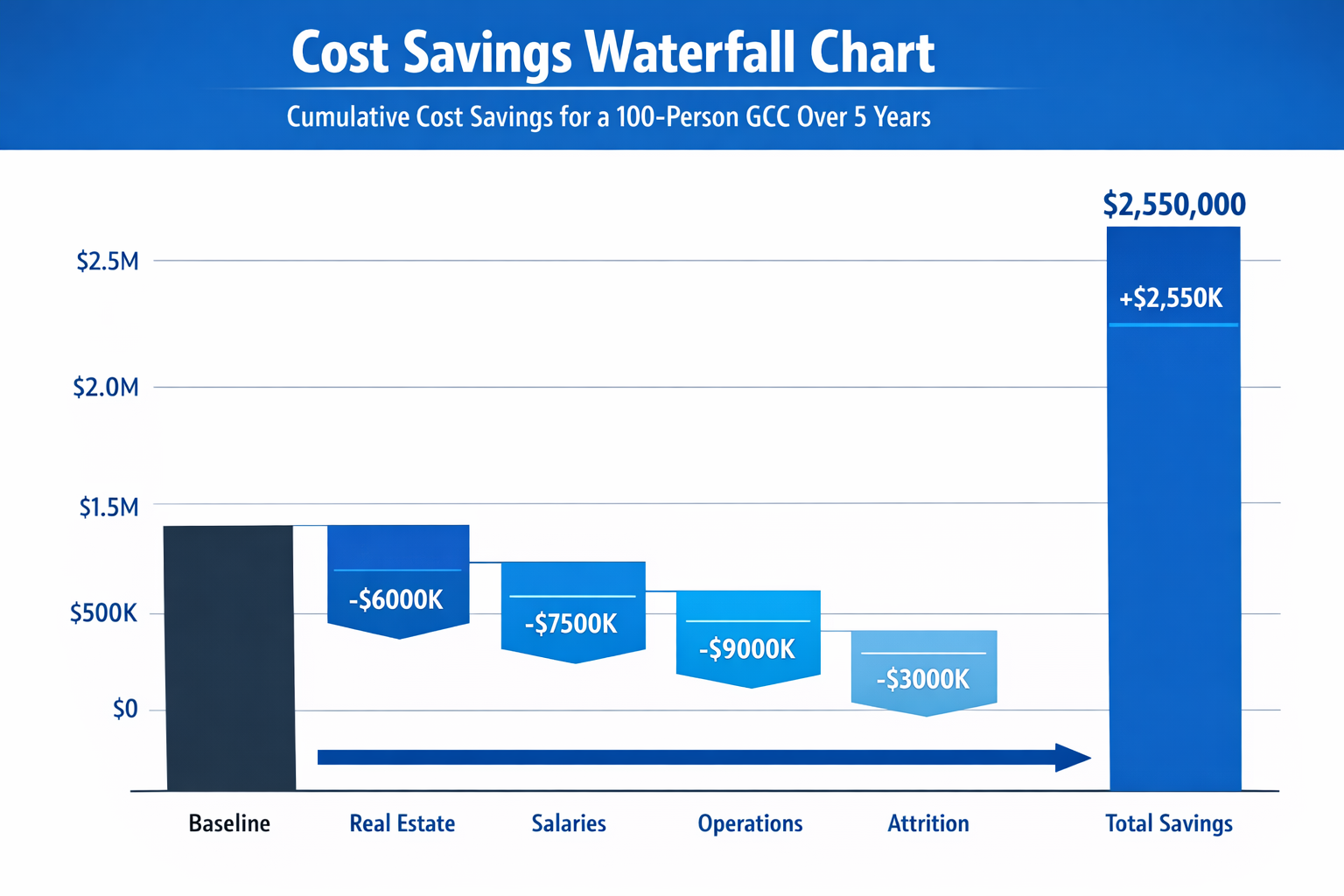
The financial case for tier 2 cities is difficult to ignore. Commercial real estate in cities like Indore, Coimbatore, and Jaipur costs 40–60% less than in Bengaluru or Mumbai. For a 100-person operation, those savings alone can fund 5–10 additional hires over five years. That is a meaningful capacity boost without incremental budget.
Beyond real estate, total operational costs covering utilities, transport, and day-to-day overheads run 35-40% lower than in tier 1 metros. Salary expectations also reflect the lower cost of living; professionals in tier 2 cities typically accept compensation packages that are 25–30% below metro benchmarks for equivalent roles and skill levels.
Cost Comparison: Tier 1 vs Tier 2 Cities
When compounded across a multi-year operating horizon, these differences translate into a total cost-of-ownership reduction of 25–30% capital that can be redirected toward innovation, capability building, or workforce expansion.
Untapped Talent Pool and Lower Attrition Rates in Tier 2 GCC Hubs
India produces over 1.5 million engineering graduates annually, and over 60% of them come from non-metro cities. This represents a massive, largely untapped workforce that tier 2 GCCs can access without competing against dozens of established tech employers for the same candidates.
The retention advantage is equally significant. Attrition in tier 1 cities like Bengaluru and Hyderabad routinely crosses 18–25% in technology roles. By contrast, tier 2 cities report attrition rates in the 12–15% range. Employees in these locations tend to view GCC positions as long-term careers rather than stepping stones, driven by stronger community roots, reduced migration fatigue, and better work-life balance.

A growing reverse-migration trend is further strengthening this talent pool. Since 2024, mid-to-senior professionals have shown increasing interest in returning to their hometowns, seeking quality-of-life improvements while maintaining career trajectories. GCCs in tier 2 cities are uniquely positioned to capture this experienced talent that would otherwise be locked into metro ecosystems.
Government Incentives Driving GCC Expansion to Tier 2 Cities
Indian state governments are actively competing to attract GCC investments outside traditional metros, and the policy landscape has matured rapidly. The Maharashtra GCC Policy 2025 uses a zonal approach offering higher payroll subsidies, power tariff concessions, full stamp duty waivers, and capital subsidies of up to ₹100 crore for companies that establish operations outside Mumbai and Pune.
Gujarat’s GCC Policy 2025–30 targets ₹10,000 crore in investment and 50,000 new jobs, with incentives covering partial salary reimbursements and professional training subsidies. Karnataka’s Beyond Bengaluru programme aims to set up 500 new GCCs across cities like Mysuru and Hubballi, targeting 3.5 lakh jobs and $50 billion in economic contribution by 2029.
At the national level, the 2025 Union Budget introduced a framework guiding states on promoting GCCs in emerging cities, covering 16 measures spanning talent development, infrastructure upgrades, and regulatory simplification. For enterprises evaluating locations, these layered incentives significantly reduce the effective cost of entry and accelerate time-to-operation.
Top Tier 2 Cities Emerging as Global Capability Center Hubs
Not all tier 2 cities are alike. Each is developing distinct strengths that align with specific GCC functions. Coimbatore has built an engineering-centric ecosystem, with GCCs focused on engineering R&D and financial services. The city has witnessed a 20% to 22% CAGR in new GCC setups over the past five years.
Ahmedabad benefits from GIFT City’s world-class infrastructure and Gujarat’s proactive policy framework, attracting GCCs in BFSI and technology services. Jaipur is carving a niche in creative design, software development, and IT services, supported by a growing talent base from Rajasthan’s expanding engineering college network.
Kochi and Thiruvananthapuram are gaining traction in analytics, digital solutions, and IT operations, benefiting from Kerala’s high literacy rates and strong English-language proficiency. Indore and Chandigarh round out the emerging landscape, offering balanced combinations of talent availability, infrastructure quality, and living standards that appeal to both enterprises and employees.
Nano GCCs and Distributed Operating Models in Smaller Cities
The nature of GCC operations in tier 2 cities is evolving beyond traditional large-scale centers. A new model, the “nano GCC,” is gaining momentum, with lean teams of under 150 professionals focused on high-value functions such as AI engineering, engineering R&D, or domain-specific analytics.
This distributed approach allows enterprises to diversify geographic risk while accessing specialized talent clusters. Tier 2 and tier 3 cities now host more emerging enterprise GCCs, reflecting a decisive move toward multi-city, talent-distributed models. This geographic diversification also strengthens business continuity planning, reducing concentration risk that comes from having all operations in a single metro.
Hybrid work models further amplify this advantage. GCCs in tier 2 cities are leveraging remote-enabled operations with desk-sharing ratios of 1.5:1 or higher, reducing physical space requirements by 20–40% per employee. The result is a leaner, more agile operating structure that scales efficiently.
Infrastructure and Quality-of-Life Improvements Accelerating GCC Growth
A frequent concern with tier 2 cities of infrastructure readiness is rapidly being addressed. GCC leasing in tier 2 cities doubled in FY25, rising from 7% to 15–20% of total GCC leasing. This growth has prompted commercial real estate developers and co-working operators to expand aggressively into these markets, improving the availability of Grade-A office spaces.
Digital infrastructure has also improved substantially, with most tier 2 cities now offering reliable high-speed internet and data center connectivity. State governments are investing in IT parks, SEZs, and dedicated technology corridors that provide GCC-ready environments.
Quality of life serves as a powerful, often underestimated advantage. Shorter commutes, lower housing costs, less congestion, and proximity to family make tier 2 cities attractive to employees. These factors directly influence retention—employees who are satisfied with their living environment are significantly less likely to pursue opportunities elsewhere, creating a stable workforce that compounds institutional knowledge over time.
Challenges to Consider When Choosing Tier 2 Cities for Your GCC
The tier 2 opportunity is substantial, but it requires a clear-eyed assessment of the trade-offs. Senior leadership and domain-specialist talent remain concentrated in metros. While the overall talent pool is growing, niche roles in areas like cloud architecture, AI/ML, and product management may command 30–50% salary premiums due to limited local supply.
Ecosystem maturity varies considerably across cities. While Coimbatore and Ahmedabad have developed robust tech communities, newer entrants like Bhubaneswar and Vadodara are still building the density of support services, from specialized recruitment agencies to professional development networks, that GCCs rely on.
Lifestyle considerations also matter for relocation decisions. Employees weigh schooling quality for children, career opportunities for spouses, healthcare access, and social infrastructure before committing to a move. Companies succeeding in tier 2 markets are addressing these holistically. They are partnering with local institutions, investing in employee experience, and building community-engagement programs that make the transition smoother.
Conclusion
The data points in one direction: tier 2 Indian cities offer a compelling, evidence-backed case for GCC expansion. Lower costs, stronger retention, growing talent pipelines, and aggressive government incentives create conditions that tier 1 metros increasingly struggle to match. The enterprises establishing tier 2 GCCs today are building durable competitive advantages that will compound as these cities mature.
For organizations evaluating their next GCC location, the strategic window in tier 2 cities is open now. Crewscale helps global enterprises navigate this transition, from location assessment and talent acquisition to operational setup. We ensure your tier 2 GCC delivers on its full potential from day one.


