


The global capability center market expanded from $40.4 billion in 2019 to a $64.6 billion in 2024, representing a 9.8% compound annual growth rate. That trajectory tells a clear story: enterprises worldwide are moving away from traditional outsourcing and building owned operational centers that deliver lasting strategic value.
For decades, outsourcing served as the default playbook for companies seeking cost savings and operational efficiency. But as digital transformation accelerates and intellectual property becomes a core competitive asset, the limitations of vendor-dependent models have become impossible to ignore. Global Capability Centers offer something outsourcing cannot: complete ownership of talent, processes, and innovation.
This article examines why GCCs are emerging as the superior model for enterprises seeking long-term competitive advantage, with a particular focus on India, the undisputed global hub for capability center operations.
Understanding the Two Models
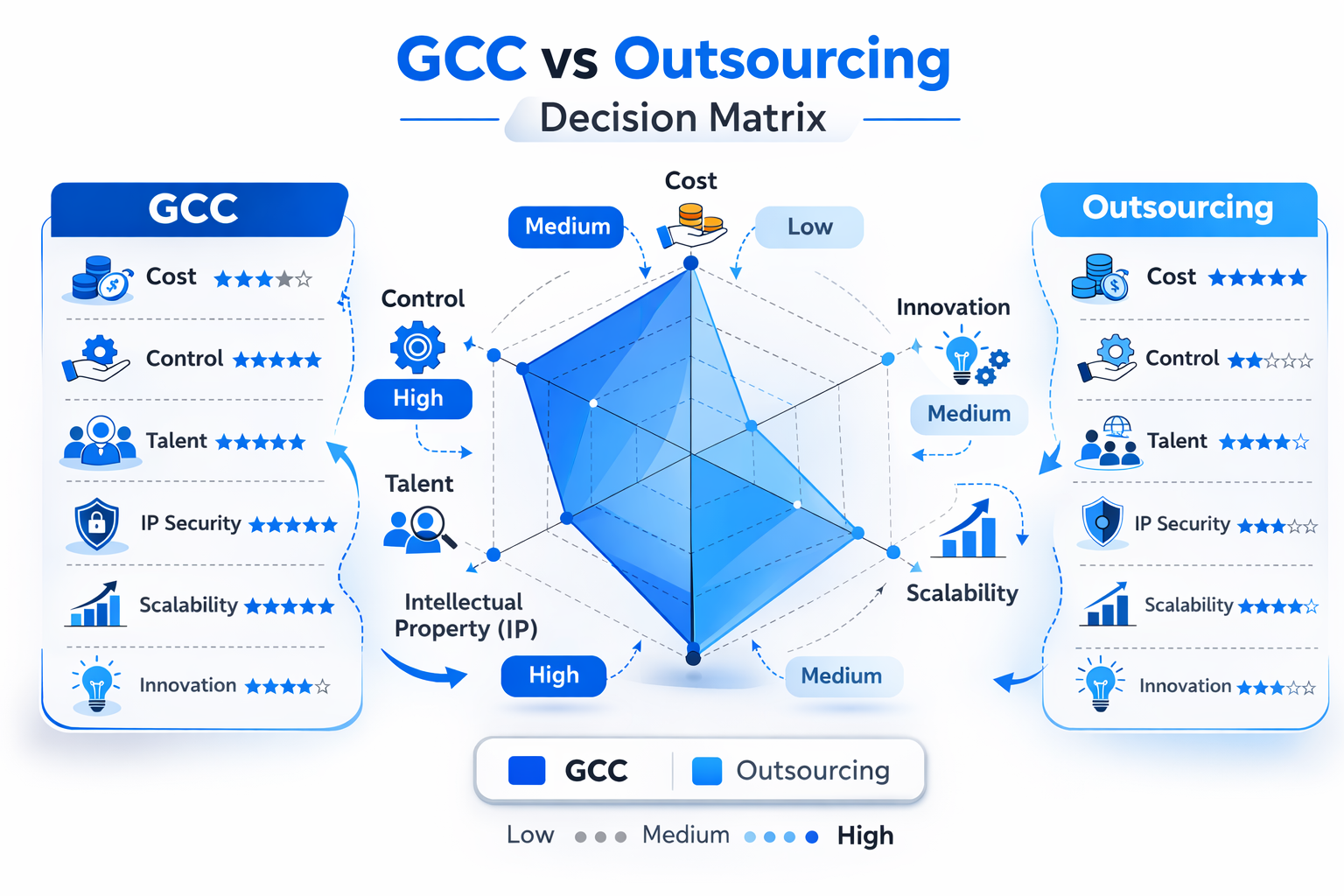
The fundamental difference between GCCs and outsourcing lies in ownership and control. A Global Capability Center is an offshore or nearshore entity wholly owned by the parent company, staffed with direct employees who work exclusively on the organization's systems, processes, and strategic objectives. Outsourcing, by contrast, distributes work to external vendors managing multiple clients simultaneously.
This distinction matters more than it appears on the surface. GCC employees develop deep institutional knowledge, align with company culture, and build proprietary expertise that compounds over time. Outsourced teams, regardless of quality, split their focus and institutional memory across client portfolios. The result is a fundamentally different relationship with innovation, accountability, and long-term value creation.
Why GCCs Deliver Superior Strategic Value
Full IP Protection and Data Governance
In regulated industries like banking, healthcare, and fintech, intellectual property security is non-negotiable. GCCs keep all IP, data, and proprietary processes within the organization's legal and operational perimeter. According to Deloitte's Global Outsourcing Survey, better control over operations and IP ranked among the top five reasons enterprises insource previously outsourced functions.
From Cost Arbitrage to Innovation Arbitrage
GCCs have evolved far beyond their origins as cost-saving back offices. The EY GCC Pulse Report 2025 found that 92% of GCC leaders affirm their centers now contribute far beyond cost savings, driving innovation, AI development, and digital transformation. With 58% of GCCs investing in Agentic AI and 83% scaling generative AI capabilities, these centers have become strategic intelligence hubs rather than mere support functions.
Talent Retention and Cultural Integration
Outsourcing vendors face inherent challenges with talent retention because employees lack direct allegiance to the end client. GCCs solve this by hiring directly under the parent brand, offering career progression tied to the organization's growth. Attrition rates in Indian GCCs have declined steadily from 13% in 2023 to 9% in 2025, driven by upskilling programs, flexible work models, and direct leadership access.
Why India Dominates the GCC Landscape
India is not just participating in the GCC revolution; it is leading it. The country hosts over 1,700 GCCs employing 1.9 million professionals and generating approximately $64.6 billion in annual revenue. Projections place this figure at $100 billion by 2030.
Unmatched Talent Ecosystem
India produces over 2.5 million STEM graduates annually, the world's second-largest output by volume. This talent pipeline spans engineering, data science, AI, cloud computing, and cybersecurity. The ecosystem includes over 120,000 AI/ML professionals and more than 185 dedicated AI/ML Centers of Excellence across GCCs. No other country offers this combination of depth, scale, and specialization.
Cost Efficiency That Scales
GCCs in India deliver 40-60% cost savings compared to equivalent operations in the United States or the United Kingdom, without compromising quality. Tier-2 cities like Ahmedabad, Coimbatore, and Thiruvananthapuram offer an additional 15-20% reduction over metro areas like Bengaluru and Hyderabad, expanding the geography of opportunity.
Government Support and Infrastructure
India's central and state governments actively court GCC investment through Special Economic Zones, tax incentives, and innovation-focused policies. Bengaluru alone hosts over 880 GCCs, while Hyderabad's Telangana AI Mission has catalyzed a vibrant technology ecosystem. GCCs now account for approximately 40% of India's Grade-A office space demand, reshaping commercial real estate across major cities.
When Outsourcing Still Makes Sense
Outsourcing is not obsolete. It remains the right choice for specific scenarios: short-term projects requiring rapid deployment, transactional processes where IP sensitivity is low, and situations demanding immediate access to niche expertise without long-term commitment. Companies exploring new markets may also use outsourcing as a testing ground before committing to a full GCC build.
The critical distinction is strategic intent. Organizations seeking speed, convenience, and flexibility for non-core functions will find outsourcing efficient. But those building long-term competitive moats around technology, data, and proprietary processes will outgrow vendor-dependent models.
The Rise of Hybrid and GCC-as-a-Service Models
The choice between GCC and outsourcing is no longer binary. Modern enterprises increasingly adopt hybrid workforce strategies that combine owned capability centers for mission-critical functions with outsourcing partnerships for transactional or rapidly scalable needs. This approach maximizes control where it matters most while preserving flexibility elsewhere.
GCC-as-a-Service (GCCaaS) has emerged as a bridge between the two models, allowing companies to launch managed capability centers within 6-12 months. A service partner handles entity formation, facilities, recruitment, and compliance, while the parent company retains full operational control and IP ownership. This model reduces the traditional 18-24 month setup timeline without sacrificing the strategic advantages of a captive center.
Conclusion
The shift from outsourcing to Global Capability Centers reflects a deeper strategic reality: enterprises that own their talent, technology, and innovation infrastructure build durable competitive advantages. India's unmatched combination of skilled talent, cost efficiency, government support, and technology depth makes it the clear destination for organizations ready to make this transition.
Start by assessing which functions in your organization demand strategic ownership versus transactional efficiency. For teams ready to build or scale a Global Capability Center, Crewscale specializes in helping organizations establish high-performing GCCs in India, from talent strategy to operational launch.


