
%20Step-by-Step%20Guide.png)

Global Capability Centers have evolved from simple cost-saving offshore units into strategic innovation engines that drive enterprise-wide transformation. Today, over 1,800 GCCs operate in India alone, employing two million professionals and generating $64.6 billion in annual revenue, a testament to the model’s proven viability.
As enterprises face mounting pressure to access specialized talent, accelerate digital transformation, and maintain operational resilience across geographies, the GCC model offers a compelling solution. Unlike traditional outsourcing, a GCC is a wholly-owned extension of your organization, giving you complete control over quality, intellectual property, and strategic direction.
This guide walks you through every aspect of setting up a Global Capability Center, from defining your strategic objectives and selecting the ideal location to navigating legal complexities, building world-class teams, and scaling operations. Whether you are a Fortune 500 enterprise or a mid-market company exploring your first offshore center, the steps outlined here provide a comprehensive roadmap to GCC success.
What Is a Global Capability Center?
A Global Capability Center (GCC), also known as a Global In-house Center (GIC) or captive center, is a wholly-owned offshore or nearshore entity established by a multinational corporation to deliver strategic business functions. These functions span IT services, research and development, engineering, data analytics, finance and accounting, customer experience, and increasingly, end-to-end product development.
What distinguishes a modern GCC from the captive centers of the early 2000s is scope and ambition. Today’s GCCs are innovation hubs that own critical technology stacks, drive AI and automation strategies, and contribute directly to global revenue generation. Nearly 50% of GCCs now handle end-to-end product delivery, far beyond their earlier role as back-office support operations.
Step 1: Define Your Strategic Objectives
Every successful GCC begins with a clear articulation of purpose. Before committing resources, leadership must answer fundamental questions about what the center will accomplish and how it fits within the broader corporate strategy.
Key Questions to Address
• Which functions will the GCC support - IT, R&D, analytics, finance, engineering, or customer operations?
• What cost savings, efficiency improvements, or innovation outcomes are expected?
• What is the target headcount over three to five years?
• How does the GCC align with the company’s long-term digital transformation roadmap?
• Will the GCC serve a single business unit or function as a shared services hub?
Organizations that treat strategic planning as a formality risk building centers that lack focus and fail to deliver measurable value. Top-performing GCCs establish clear KPIs from day one, covering operational efficiency, talent metrics, innovation contribution, and alignment with corporate goals.
Step 2: Conduct a Comprehensive Feasibility Study
A thorough feasibility study evaluates the viability and risks of establishing a GCC in your target regions. This analysis should cover talent availability, infrastructure maturity, regulatory environment, cost structures, geopolitical stability, and ease of doing business.
Core Assessment Areas
The feasibility study should also include a financial model projecting initial setup costs, ongoing operational expenses, and break-even timelines. Enterprises typically find that initial infrastructure costs range from $200,000 to $1 million, depending on scale, location, and industry requirements.
Step 3: Select the Right Location
Location selection is arguably the most consequential decision in the GCC setup process. The right city balances talent depth, operational costs, infrastructure quality, and government support.
Leading GCC Destinations
India remains the undisputed leader in the global GCC landscape, hosting more than half of all GCCs worldwide. Cities like Bengaluru, Hyderabad, Pune, Chennai, and Delhi NCR offer deep talent pools in technology, engineering, and analytics. Tier-2 cities such as Coimbatore, Jaipur, and Kochi are emerging as attractive alternatives, delivering 35% cost savings over metropolitan centers while maintaining access to quality talent.
Beyond India, Poland serves the European market with strong engineering talent, while Mexico offers proximity advantages for North American operations. Vietnam and the Philippines are gaining traction in customer operations and IT services. However, India’s unmatched combination of scale, English proficiency, a mature GCC ecosystem, and supportive government policies, including 100% FDI allowance in most sectors, makes it the default starting point for most enterprises.
Step 4: Choose Your Operating Model
The operating model determines your GCC’s legal structure, ownership, and operational responsibility. Each model carries distinct implications for control, speed, cost, and risk.
Common Operating Models
Most Fortune 500 companies opt for a wholly-owned subsidiary for maximum control over intellectual property and operations. However, the Build-Operate-Transfer model has become the preferred strategy for enterprises entering India in 2026, allowing them to begin operations quickly while an experienced partner handles initial setup, talent acquisition, and compliance before transferring full ownership.
Step 5: Navigate Legal Setup and Compliance
The legal and regulatory framework underpinning your GCC affects everything from tax treatment and IP protection to employment practices and data governance. A misstep here can result in fines, operational disruptions, or reputational damage.
Entity Registration
For GCCs in India, the most common approach is registering as a private limited company or a wholly-owned subsidiary under the Companies Act, 2013. This involves obtaining approval from the Reserve Bank of India (RBI) for FDI compliance, registering with the Ministry of Corporate Affairs, and securing PAN and TAN numbers for tax purposes.
Critical Compliance Areas
1. Tax and Transfer Pricing: Register for GST, establish transfer pricing documentation for intercompany transactions, and identify eligibility for Special Economic Zone (SEZ) tax incentives.
2. Employment Law: Draft employment contracts compliant with local labor regulations, including provisions for Provident Fund, Employee State Insurance, and gratuity.
3. Data Protection and IP: Establish data governance policies aligned with the Digital Personal Data Protection (DPDP) framework and international standards like GDPR and ISO 27001. Ensure all employment and vendor agreements contain robust IP assignment clauses.
4. Industry-Specific Regulations: Sectors such as banking, healthcare, and defense may require additional licenses and regulatory clearances.
Step 6: Hire Leadership and Build Your Team
The GCC leader you appoint will define the center’s culture, velocity, and strategic trajectory. Research from BCG reveals that 92% of underperforming GCCs keep decision-making highly centralized at headquarters, while top performers grant their GCC leaders meaningful autonomy to drive local strategy and talent decisions.
Leadership Hiring Priorities
• Appoint a GCC head who can bridge cultural differences between the parent organization and the host country
• Hire senior technical and functional leaders within the first 60 days
• Prioritize candidates with experience scaling teams in your target geography
Talent Acquisition Strategy
India produces millions of STEM graduates annually, offering one of the world’s deepest pools of engineering, data science, and technology talent. To compete in this market, GCCs must adopt modern recruitment practices: AI-driven sourcing tools, skills-based hiring over credential-based screening, and competitive compensation packages. According to Aon’s Employee Sentiment Study, the top factors influencing employee choices are above-average pay and meaningful benefits (47%), followed by workplace culture and value alignment
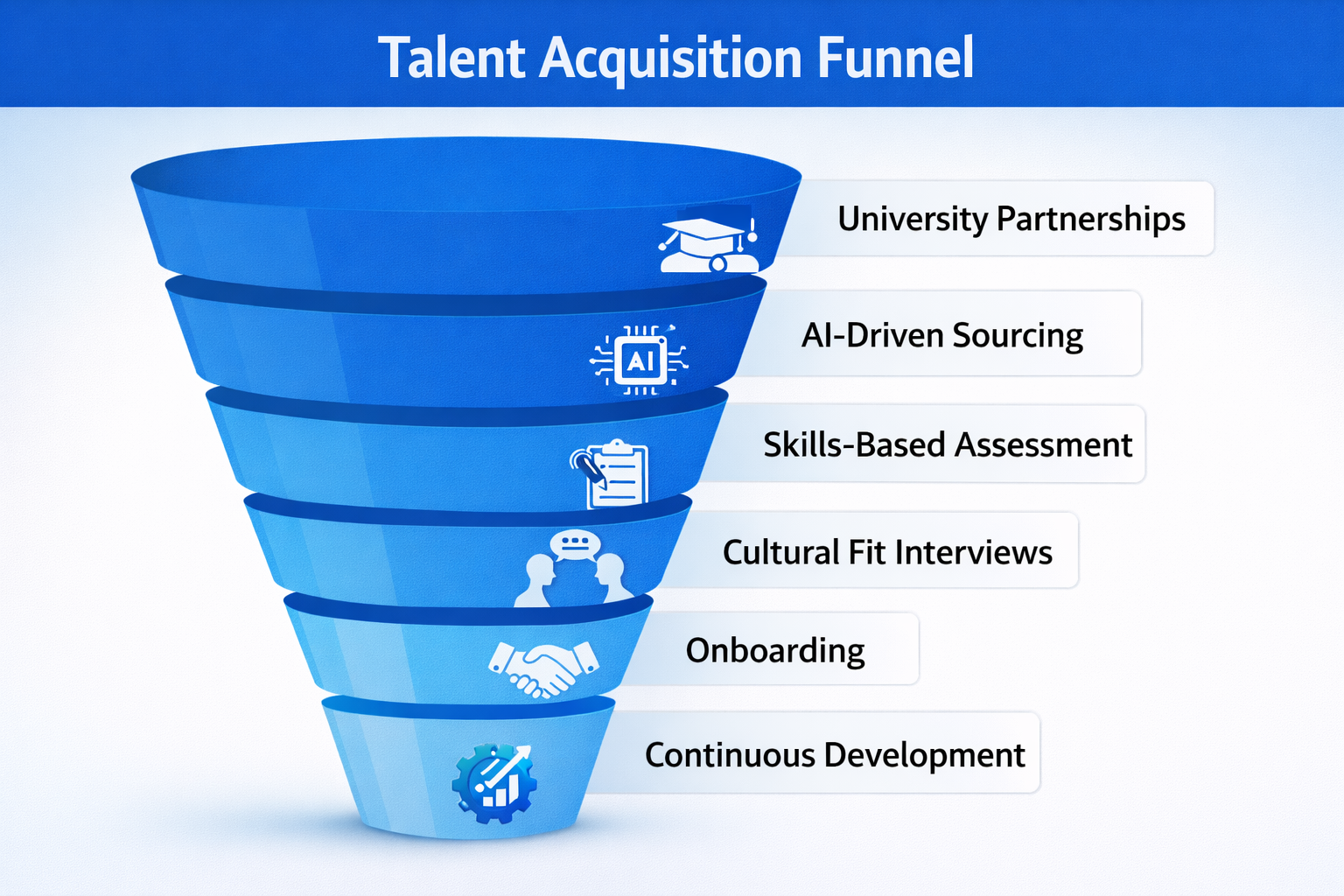
Retention is equally critical. Top GCCs invest in structured upskilling programs, mentorship connecting junior staff with parent company leaders, and locally tailored employee value propositions. Academic partnerships for curriculum co-creation ensure a steady pipeline of graduates with industry-relevant skills.
Step 7: Set Up Infrastructure and Technology
Infrastructure setup encompasses physical workspace, IT systems, security architecture, and operational tooling. The decisions you make here directly impact productivity, collaboration, and compliance.
Workspace Considerations
• Evaluate managed office spaces, co-working facilities, or purpose-built campuses based on your scale and timeline
• Special Economic Zones (SEZs) offer tax benefits and enterprise-grade facilities in many Indian cities
• Design the workspace to support hybrid work models, which are now standard across GCC operations
• GCCs accounted for 37% of all Grade A office leasing in India in 2025, signaling strong demand for premium commercial spaces
Technology Stack
Deploy cloud infrastructure aligned with the parent company’s architecture. Establish VPN connectivity, identity and access management, and endpoint security. Implement collaboration tools that bridge time zones. India’s GMT+5:30 position enables a follow-the-sun model with both US and European headquarters
Step 8: Establish Cultural Integration and Governance
Cultural alignment between the GCC and headquarters is the invisible factor that determines long-term success or failure. BCG research finds that 50% of top-performing GCCs have locally tailored employee value propositions, compared to just 8% of underperformers.
Building a Hybrid Culture
• Conduct cultural assessments of both the parent organization and the host country before designing integration strategies
• Create a hybrid culture that blends the best elements of corporate identity with local norms and work preferences
• Establish regular cross-border collaboration rituals: joint sprint planning, shared OKRs, and executive exchanges
• Implement governance frameworks that balance local autonomy with global standards
Governance Framework
Define clear reporting lines, escalation paths, and decision-making authority. Establish a steering committee with representatives from both headquarters and the GCC. Implement standardized performance metrics and review cadences to maintain alignment while empowering local leadership to operate with agility.
Step 9: Launch, Measure, and Scale
With the foundational elements in place, the focus shifts to operational launch, continuous measurement, and strategic scaling. A structured approach to this phase transforms your GCC from a fledgling operation into a mature capability center.
Launch Timeline
Depending on your chosen operating model and location, a typical GCC can become operational in 12 to 24 weeks using an accelerated setup partner, or six to eight months for a fully self-managed launch. India’s mature ecosystem of GCC setup partners, managed office providers, and talent acquisition agencies significantly compresses these timelines compared to less established markets
Key Performance Indicators
Scaling Strategies
Once your GCC demonstrates consistent delivery, consider expanding into adjacent functions, adding new service lines, or opening satellite offices in Tier-2 cities for cost optimization. The Indian GCC ecosystem is projected to grow into a $110+ billion market by 2030, signaling sustained demand for capability center operations across all major industries.
Common Pitfalls to Avoid
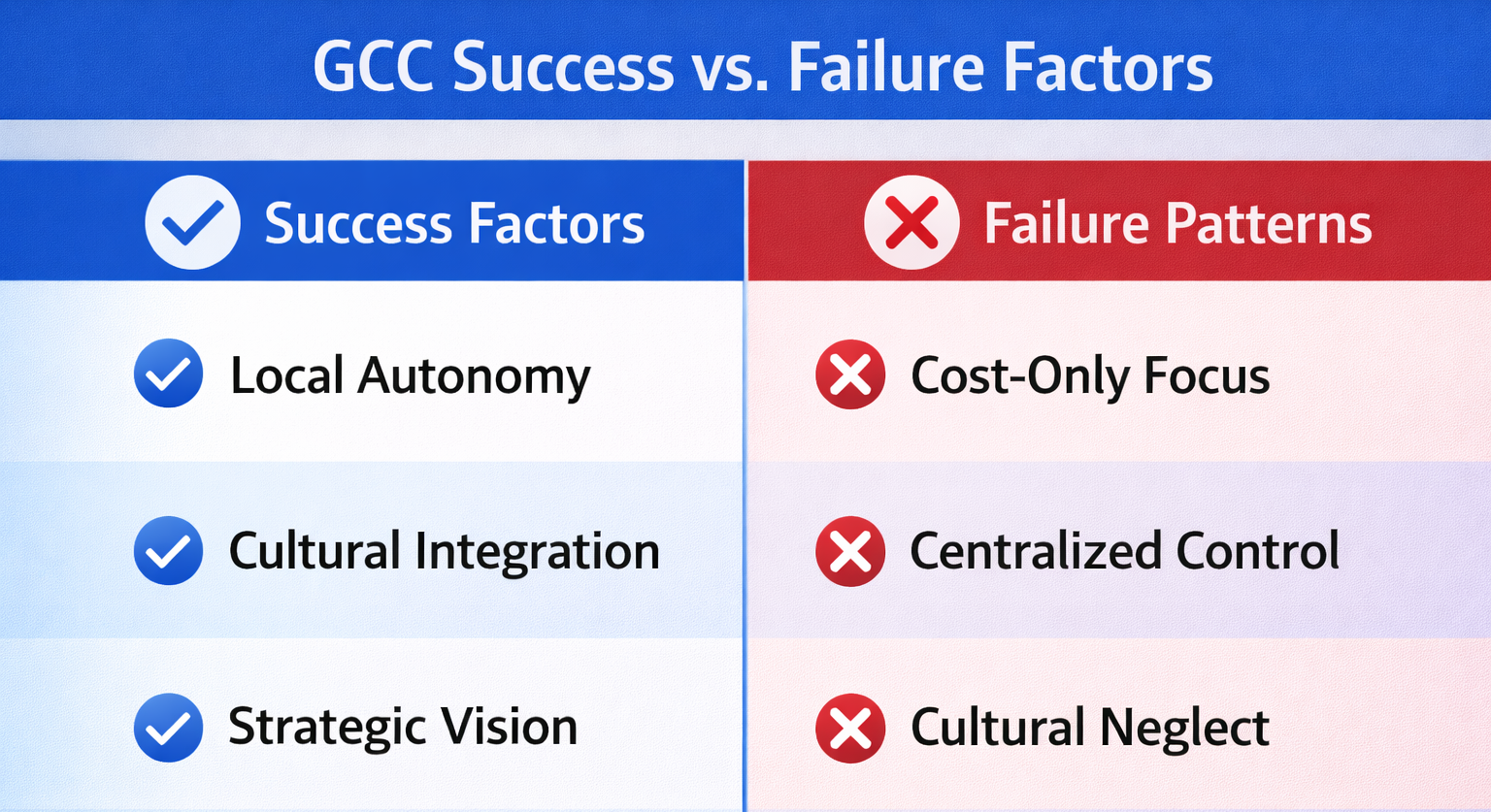
Even well-funded GCC initiatives can stumble. Understanding the most frequent failure patterns helps you build safeguards into your setup plan from the outset.
1. Treating the GCC as a Cost Center: Organizations that view their GCC purely as a mechanism for labor arbitrage miss the strategic potential. The most impactful centers combine cost efficiency with innovation, product ownership, and business transformation.
2. Over-Centralizing Decision-Making: Headquarters that micromanage their GCC operations create bottlenecks and demoralize local talent. Empower your GCC leaders with clear mandates and decision-making authority.
3. Underinvesting in Culture: Neglecting cultural integration leads to an “us vs. them” dynamic that erodes collaboration and drives attrition.
4. Skipping the Feasibility Study: Rushing into a location without proper analysis often leads to talent mismatches, unexpected regulatory burdens, or infrastructure limitations.
5. Ignoring Compliance Complexity: Transfer pricing violations, data protection lapses, or employment law noncompliance can result in significant financial and legal consequences.
Why India Continues to Lead the GCC Landscape
While multiple countries compete to attract GCC investments, India’s dominance is not accidental. The country’s GCC ecosystem has matured over two decades, creating a self-reinforcing cycle of talent development, infrastructure investment, and institutional knowledge that newer destinations cannot easily replicate.
India produces the world’s largest pool of STEM graduates, with global leadership roles originating from Indian GCCs growing at a 40% CAGR over the past five years, reaching over 6,500 leadership positions, including more than 1,050 women leaders. This depth of homegrown leadership talent is unique to the Indian market.
The Indian government’s supportive stance—allowing 100% FDI in most sectors, offering SEZ incentives, and investing in digital infrastructure—further strengthens the business case. With Bengaluru alone housing 880+ GCCs and serving as the country’s deepest ER&D and AI talent hub, the ecosystem’s maturity offers new entrants a significant operational advantage through established vendor networks, talent benchmarks, and proven playbooks.
Conclusion
Setting up a Global Capability Center is a multifaceted undertaking that demands strategic clarity, disciplined execution, and a long-term perspective. From defining objectives and selecting the right location to navigating legal complexities and building high-performing teams, every step shapes the center’s ability to deliver sustained value across cost efficiency, innovation, and operational resilience.
Start by aligning leadership on the GCC’s strategic purpose, then invest in a thorough feasibility study before committing to a location and operating model. For organizations seeking expert guidance through this process, Crewscale specializes in helping enterprises establish and scale high-performing Global Capability Centers with the right talent, structure, and operational foundations.


