


India hosts over 1,800 Global Capability Centers, employing nearly two million professionals and generating $64.6 billion in annual revenue. For US companies eyeing this opportunity, building a GCC in India promises access to world-class engineering talent at competitive costs. Yet beneath the surface of this growth story lies a compliance landscape that can derail even the most well-funded expansion if overlooked.
India’s payroll system is governed by a dense web of central and state-level statutes, each with its own registration requirements, contribution rates, filing deadlines, and penalties. The stakes rose further in November 2025, when four new Labour Codes took effect, consolidating 29 legacy laws and introducing sweeping changes to salary structures, social security, and worker classification.
This article breaks down every payroll compliance obligation US companies must navigate when setting up a GCC in India—from statutory deductions and filing calendars to the structural decisions that shape your compliance burden from day one.
Salary Structure Under the New Labour Codes
The most consequential change under the 2025 Labour Codes is the 50% basic pay rule. Every employee’s basic salary plus dearness allowance must now equal at least 50% of their Cost to Company (CTC). This single mandate restructures how Indian compensation works and directly impacts employer contribution costs.
For US companies accustomed to flexible compensation design, this creates a material shift. Provident Fund and gratuity contributions are calculated on basic pay, so a higher basic salary floor means higher statutory costs. Employee benefits in India typically add 20–30% on top of base salary, with statutory contributions alone accounting for 15–20%.
The reforms also reduced gratuity eligibility for fixed-term employees from five years to one year, expanding the pool of employees entitled to gratuity payouts. US companies hiring contract or project-based staff should factor this into workforce planning.
Mandatory Statutory Deductions
India’s payroll system requires employers to calculate, deduct, and remit contributions across four primary statutory frameworks. Missing any of these can trigger penalties, interest charges, and in severe cases, criminal prosecution.
Employees’ Provident Fund (EPF)
Mandatory for establishments with 20 or more employees, EPF requires both the employer and employee to contribute 12% of basic salary plus dearness allowance. The employer’s share is split between the EPF account (3.67%) and the Employees’ Pension Scheme (8.33%). Registration with the EPFO is required before processing your first payroll.
Employees’ State Insurance (ESI)
ESI provides health insurance coverage for employees earning up to ₹21,000 per month. Employers contribute 3.25% of gross salary, while employees contribute 0.75%. While many GCC roles may exceed this threshold, support and operations staff often fall within the ESI bracket.
Tax Deducted at Source (TDS)
Employers must deduct income tax monthly based on projected annual earnings under the employee’s chosen tax regime. This requires obtaining a TAN from the Income Tax Department, filing quarterly returns via Form 24Q, and issuing Form 16 certificates annually. Missing TDS deadlines can attract penalties of up to ₹1,000 per day.
Professional Tax
Levied by state governments, professional tax rates and rules vary significantly across jurisdictions. States like Maharashtra, Karnataka, Tamil Nadu, and West Bengal impose mandatory deductions. US companies often underestimate this because it has no federal equivalent—but non-compliance at the state level carries real penalties
Critical Filing Deadlines
India’s payroll compliance calendar is unforgiving. Multiple filings are due every month, quarter, and year, each governed by a different authority with its own portal and format. Late filings attract not just penalties but interest on unpaid amounts
Building a compliance calendar before your first hire in India is non-negotiable. Many US companies discover these deadlines only after incurring penalties, a costly lesson that proper planning eliminates.
Registration and Entity Setup for GCCs
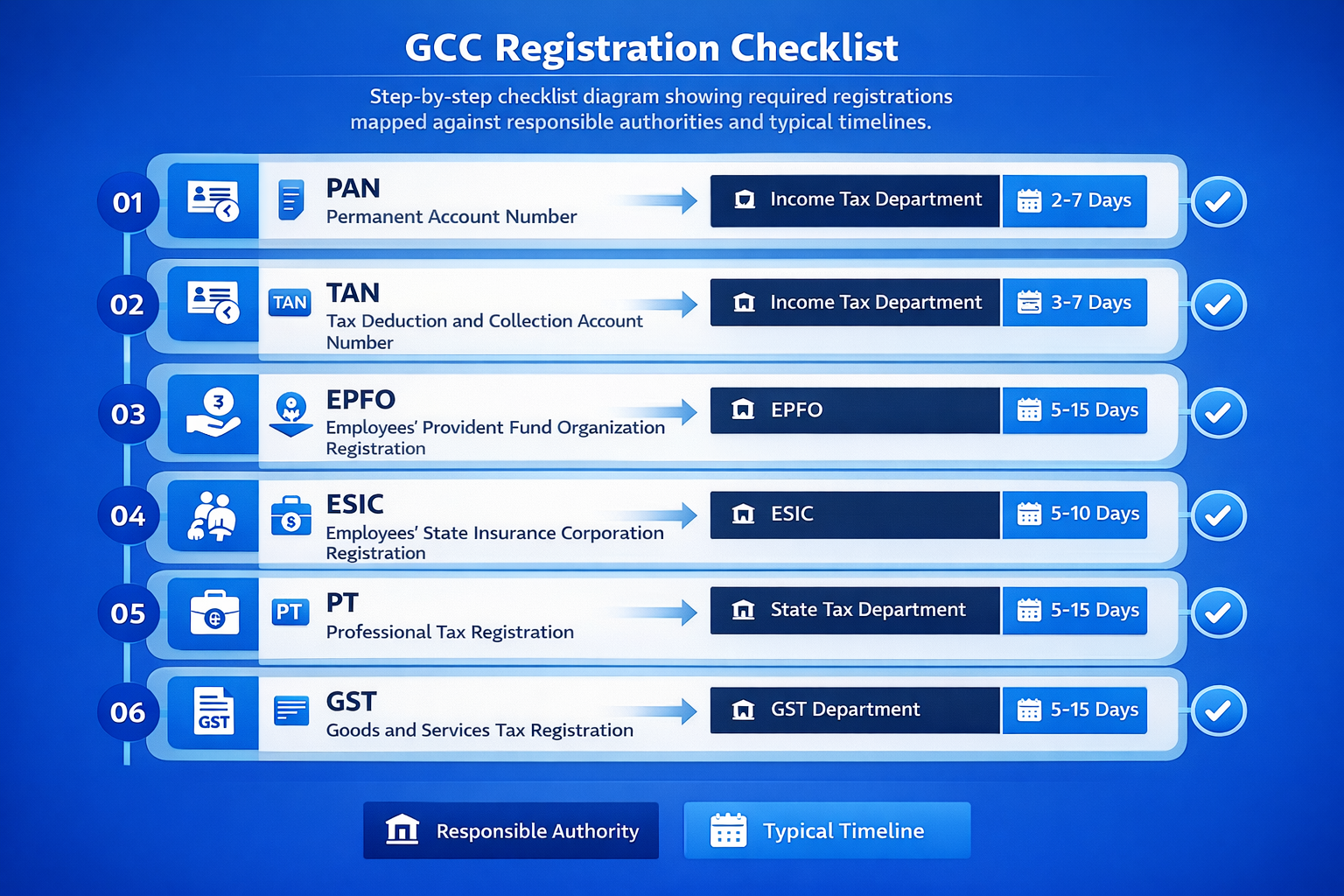
Before processing a single payroll, your Indian entity must complete registrations across multiple authorities. The choice of legal entity structure, typically a wholly-owned subsidiary under the Companies Act, 2013, determines the scope of your compliance obligations.
Required registrations include PAN and TAN from the Income Tax Department, EPF registration from EPFO, ESI registration from ESIC, professional tax registration in applicable states, and GST registration. Each registration is a prerequisite for lawful payroll operations.
GCCs must also address cross-border considerations, including transfer pricing documentation for intercompany services, compliance with the Digital Personal Data Protection Act, 2023 (particularly for employee data flows), and employee secondment policies if transferring staff between US and Indian operations.
Navigating State-Level Complexity
India’s federal structure means payroll compliance is never purely a central government exercise. Labour laws, shops and establishments acts, and professional tax regulations vary across states, and your GCC’s location directly shapes your compliance requirements.
Bengaluru, which hosts roughly 35–40% of India’s GCCs, operates under Karnataka’s professional tax and labour regulations. Hyderabad falls under Telangana’s regime. Emerging GCC hubs like Pune (Maharashtra) and Chennai (Tamil Nadu) each have distinct compliance frameworks. Companies are expanding to Tier-2 cities, a growing trend driven by cost optimization, which must account for yet another set of state-specific rules.
The practical implication: a multi-city GCC strategy multiplies your compliance surface. Each location requires separate professional tax registrations, potentially different minimum wage rates, and adherence to local shops and establishments acts governing working hours, leave policies, and employment terms.
Common Pitfalls for US Companies
US companies entering India frequently stumble on compliance issues that experienced local operators consider routine. Understanding these pitfalls upfront can save months of remediation.
• Misclassifying workers: India’s new Labour Codes expanded coverage to gig workers and platform workers. Treating contractors as employees or vice versa triggers backdated statutory contributions and penalties.
• Ignoring state-level obligations: Professional tax and shops and establishments compliance are easy to overlook when your compliance framework is designed around central laws alone.
• Salary structure misconfiguration: Failing to meet the 50% basic pay threshold under the new Labour Codes can invalidate your entire payroll structure retroactively.
• Delayed registrations: Processing payroll before completing EPFO, ESIC, or TAN registrations exposes the company to penalties from the first pay cycle.
Conclusion
India’s payroll compliance framework demands precision across salary structuring, statutory deductions, multi-authority registrations, and state-specific obligations. For US companies building GCCs, treating compliance as a foundational workstream—not an afterthought—is the difference between a smooth launch and costly remediation. The 2025 Labour Code reforms make this even more critical, with restructured salary rules and expanded worker coverage raising the baseline for compliant operations.
Start by mapping your compliance obligations to your chosen entity structure and location, then build your filing calendar before your first hire. For organizations seeking expert guidance on navigating India’s regulatory landscape, Crewscale specializes in helping US companies establish and scale compliant GCC operations in India. The companies that get compliance right from day one are the ones that scale fastest.


