


It is 11 PM on a Thursday. A revenue operations manager is staring at a spreadsheet containing 3,000 rows of lead data from a webinar, a LinkedIn campaign, and two regional events. The data needs enrichment, deduplication, CRM field mapping, and round-robin distribution to SDRs. An engineer could automate this in a day, but their request sits at number forty-seven in the engineering backlog. So the manager does something unexpected: they open a vibe coding platform and describe the solution in plain English. By Friday morning, the tool is live.
This is not a hypothetical future. Revenue operations teams across the industry are using AI-assisted development, commonly called vibe coding, to build custom micro tools that solve niche workflow problems without writing a single line of code by hand. According to McKinsey, 88% of organizations now use AI in at least one business function, and RevOps teams are among the fastest adopters. This article explores how they are doing it, what they are building, and how you can start.
What Is Vibe Coding, and Why Should RevOps Care?
Vibe coding means building software by describing what you want in natural language and refining the result through conversation with an AI agent. There is no syntax to memorize, no framework to learn, and no pull requests to submit. You explain the problem, the AI generates the code, and you iterate until the tool works. The concept captures a fundamental shift: the builder's job is no longer to write code but to communicate intent clearly.
RevOps is a particularly strong fit for this approach. Operations professionals already understand how applications communicate through APIs because they work with CRM integrations daily. They handle structured data in CSVs and reports, know their business workflows intimately, and routinely customize platforms like Salesforce and HubSpot. If you have ever built a complex CRM report or configured an automation workflow, you already possess the foundational thinking that vibe coding requires.

Until recently, non-technical teams faced two options when they needed a custom tool: submit an engineering request and wait months, or settle for an off-the-shelf SaaS product that only partially fit their workflow. Vibe coding introduces a third path. The barrier between having an idea and having a working tool has collapsed. Gartner predicts that 40% of enterprise applications will feature task-specific AI agents by 2026, up from less than 5% in 2025, underscoring how rapidly this capability is becoming mainstream.
What RevOps Teams Are Actually Building
The most compelling evidence for vibe coding is not theoretical. It comes from the tools that revenue operations teams have already shipped. Three categories of micro tools illustrate the breadth and impact of this movement.

Mock Data Generation for Sales Demos
Sales teams need realistic demonstration environments populated with believable deal data, complete with customizable distribution curves, date ranges, and field configurations. Manually creating this data takes hours of tedious entry. One RevOps director partnered with a head of partnerships to build a mock deal generator in a single Friday afternoon session. Neither had a software engineering background. The tool integrates directly with their CRM and demo workspaces, converting what was once hours of manual work into a process that completes in seconds.
Automated Lead Processing and CSV Enrichment
Consolidating lead data from multiple sources, including webinar signups, LinkedIn campaigns, and event registrations, is one of the most common RevOps pain points. These records arrive as messy CSVs that need enrichment from data providers, field mapping to CRM properties, and distribution through round-robin logic to the sales development team. One go-to-market team built a purpose-designed tool that handles this entire pipeline automatically, achieving a 90% reduction in lead processing time. The underlying philosophy is simple: CSV files remain important as data interchange formats, but humans should never be manually inspecting or manipulating them.
AI-Powered Sales Training Simulators
Perhaps the most creative application involves sales enablement. A go-to-market leader built an AI sales training simulator in under two hours during his first two weeks on the job. The tool lets reps practice cold calls and discovery calls against AI personas that match actual buyer profiles. Reps can select buyer types, choose between sales frameworks like MEDDIC or Sandler, adjust difficulty levels, and receive performance scoring tied to the chosen methodology. The result: onboarding ramp periods that traditionally span three months compress to under two weeks. The tool now serves triple duty across interview preparation, new hire training, and ongoing coaching.
The Build vs. Buy Calculus Has Changed
The traditional build-versus-buy decision assumed that building required significant engineering investment in time, salary, and opportunity cost. Vibe coding dramatically reduces the "build" side of that equation, shifting the analysis for an entire class of tools.
To be clear, building is not about replacing your core stack. Your CRM, marketing automation platform, and communication tools should remain purchased products with dedicated vendor support. What vibe coding addresses is the connective tissue between those platforms: the micro tools and niche workflows where purchasing means compromising on fit or waiting months for vendor roadmaps to catch up.
Research shows that sales teams using specialized AI tools generate 77% more revenue per rep than those relying on generic solutions. The implication for RevOps is clear: tools built to match your exact workflow outperform tools that require your workflow to adapt.
Building a Culture of Builders
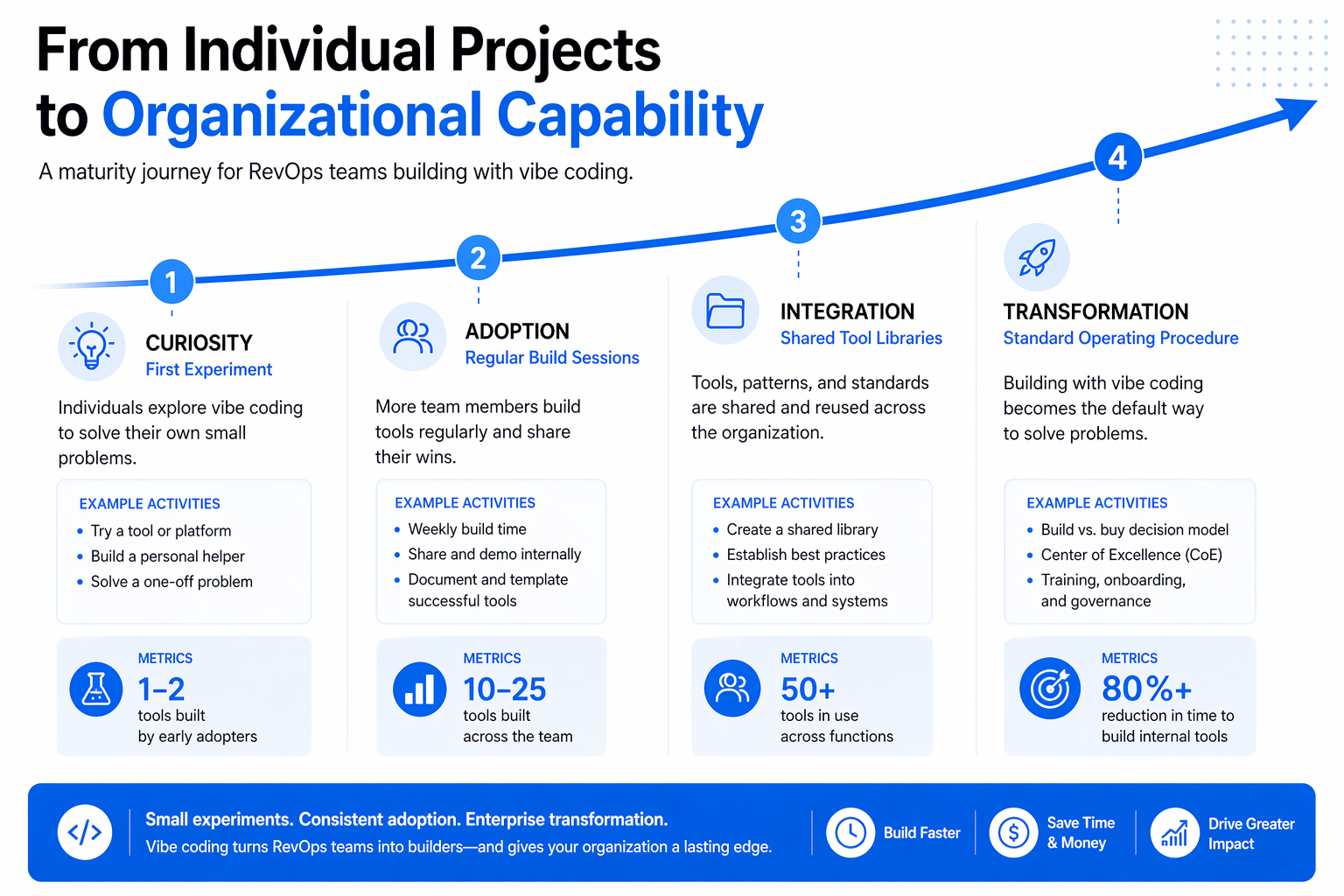
The most forward-thinking organizations are treating vibe coding not as an individual skill but as a team capability. Some companies have introduced regular AI-building sessions where salespeople, customer success representatives, account managers, and even engineers participate together. The philosophy is that building should be a standard operational activity, not a specialized engineering project.
This cultural shift creates two powerful competitive advantages. First, it eliminates the vendor evaluation bottleneck. When a workflow problem surfaces on Monday, a team with building capability can have a working solution by Tuesday. The traditional path of researching vendors, scheduling demos, negotiating contracts, and implementing software might not deliver for quarters. Second, it removes internal engineering queue dependencies. Every custom tool that RevOps builds for itself is one fewer ticket in the engineering backlog, freeing developers to focus on core product work.
The key to making this stick is embedding building into team rhythms: dedicated build time, shared internal tool libraries, and regular showcases where colleagues demo what they have created. Even sessions that do not produce a permanent tool still train teams to think in terms of custom solutions rather than manual workarounds. A Gartner survey found that 57% of high-maturity AI organizations report business units that actively trust and adopt new AI solutions, compared to just 14% of low-maturity organizations. Building culture is the differentiator.
How to Get Started: A Practical Framework
If you work in RevOps and have customized a CRM, built complex reports, set up automation workflows, or enriched CSV files, you already have the foundational knowledge for vibe coding. The concepts that matter most are understanding what APIs do (how applications exchange data), basic database structures, webhooks (event-driven triggers), and your business tools' data models. These are concepts RevOps professionals use daily, even if they do not use those technical labels.
Choosing Your First Project
Start with a pain point you experience weekly: something repetitive, data-heavy, and currently manual. Good candidates include data formatting and cleanup routines, automated report generation, lead routing logic, and simple integrations between two tools. Avoid mission-critical systems, anything requiring complex security architecture, or tools that would replace established enterprise software. Your first build should be low-stakes but high-frequency, saving thirty minutes every week rather than attempting to transform an entire workflow at once.
Leveraging Connectors and Integrations
Modern vibe coding platforms offer pre-built connectors to CRMs, customer support tools, and data enrichment providers. These connectors eliminate the hardest part of building: authentication flows, API documentation, and credential management. With single-click authentication, you can start working with live data immediately, focusing on solving the business problem rather than wrestling with technical plumbing. 54% of infrastructure leaders cite cost optimization as their top goal for AI adoption, and connector ecosystems are central to delivering that efficiency.
A Five-Day Quick-Start Plan
Monday: Identify your most painful repetitive workflow and write a plain-language description of what a solution would do.
Tuesday: Sign up for a vibe coding platform and explore its connector ecosystem. Verify it integrates with your core tools.
Wednesday: Describe your tool idea to the AI agent. Let it suggest architecture, services, and APIs. Treat it as your technical advisor.
Thursday: Build and test. Iterate through conversation, refining inputs and outputs until the tool matches your workflow.
Friday: Demo to your team. Gather feedback. Plan your next build.
The Road Ahead: Vibe Coding as the New Spreadsheet Literacy
Just as Excel proficiency became a baseline expectation for business professionals over the past two decades, vibe coding is following a similar trajectory for operations teams. The share of marketers using generative AI in at least one recurring workflow reached 87% in Q1 2026, up from 51% just two years earlier. RevOps teams are on the same curve, and organizations developing this capability now are building advantages that compound over time. Each micro tool represents institutional knowledge captured in software, and each build session trains the team to solve problems faster.
The most sophisticated internal tool ecosystems did not start with grand architectural plans. They started as single Friday afternoon projects. One team built a mock data generator, then a lead enrichment pipeline, then a training simulator, then a call sequencing tool. Incremental builds accumulate into a powerful operational infrastructure. The organizations that embed AI as a core driver of their go-to-market strategy are already outperforming their peers. The question is not whether RevOps teams will build their own tools. It is whether yours will be early or late.
Conclusion
Vibe coding has transformed RevOps from a team that requests tools to one that builds them, cutting lead processing time by 90%, compressing sales onboarding from months to weeks, and eliminating dependency on engineering backlogs. The gap between identifying a workflow problem and having a working solution has shrunk from months to hours.
Identify your most painful repetitive workflow this week, describe the solution in plain language, and try building it. For teams seeking expert guidance on implementing AI-driven revenue operations strategies, Crewscale specializes in helping organizations build and scale these capabilities faster. Your afternoon project today could be your team's most valuable tool next quarter.


