


India now hosts over 1,800 Global Capability Centers employing two million professionals and generating $64.6 billion in annual export revenue in 2024. For multinational companies setting up offshore engineering teams in India, this scale represents an extraordinary opportunity—but it also brings a compliance obligation that can make or break the financial case for offshoring: transfer pricing.
Transfer pricing governs how parent companies and their Indian subsidiaries price intercompany transactions such as service fees, cost allocations, and intellectual property charges. Get it wrong, and penalties can reach 100–300% of the tax shortfall. Get it right, and your GCC operates with predictable margins, minimal audit exposure, and full regulatory clarity.
This article breaks down the transfer pricing framework that applies to offshore engineering teams in India, examines the methods available for setting arm's length prices, and highlights the significant reforms introduced in India's Union Budget 2026 that are reshaping compliance for GCCs.
Why Transfer Pricing Matters for Offshore Engineering Teams
When a multinational sets up a GCC in India, the Indian entity typically provides engineering services, such as software development, R&D, QA, and data engineering, to the parent company or other group entities abroad. The fee charged for these services is an intercompany transaction, and Indian tax authorities scrutinize it to ensure the Indian entity earns a fair, market-rate return for its work.
The core regulatory concern is profits shifting. Without transfer pricing rules, a parent company could pay its Indian subsidiary below-market rates, effectively shifting taxable profits out of India. The Income-tax Act, 1961, codifies this through Sections 92A to 92F, requiring all international transactions between Associated Enterprises to be priced at arm's length—meaning the price must reflect what two unrelated parties would agree upon in an open market.
For engineering teams specifically, this scrutiny extends beyond simple service fees. Indian Revenue authorities increasingly examine the entire value chain of the MNE group, assessing whether the Indian entity's contribution to intellectual property creation, product development, and innovation is adequately compensated. The notion that risks can be controlled remotely by the parent company while the Indian subsidiary performs core R&D functions as a "risk-free entity" has not been accepted by Indian tax tribunals.
Methods for Determining Arm's Length Pricing
India's transfer pricing regulations prescribe five methods for establishing arm's length prices. The choice depends on the nature of the transaction, availability of comparable data, and the GCC's operational model.
For most GCCs operating as captive service providers, the Cost Plus Method or TNMM is the default approach. The Cost Plus Method is conceptually straightforward: the Indian entity's operating costs (salaries, infrastructure, overhead) form the base, and a markup is applied to determine the service fee charged to the parent. The critical question then becomes: what markup is appropriate?
Safe Harbour Rules: The 2026 Game-Changer
India's Union Budget 2026 introduced the most significant overhaul of transfer pricing safe harbour provisions in a decade, directly benefiting GCCs with offshore engineering teams
What Changed
Previously, GCCs faced a fragmented system where software development services carried a safe harbour margin of 17–18%, while contract R&D could attract margins as high as 24%. This created classification disputes—if the tax authority disagreed with a GCC's characterization of its services, the resulting litigation could drag on for years.
Budget 2026 resolves this by clubbing all IT services—software development, IT-enabled services, KPO, and contract R&D—into a single "information technology services" category with a uniform 15.5% safe harbour margin on operating costs.
Why 15.5%?
The margin was calibrated to reflect actual commercial reality. Historical safe harbour rates of 20–22% (introduced in 2013) were rejected by most companies because they exceeded real returns. The landmark Unilever India bilateral APA, which settled years of litigation over R&D service pricing, agreed on a 16.7% margin. The new 15.5% rate sits just below this benchmark, making safe harbour genuinely attractive for the first time.
Impact on GCCs
The expanded threshold means an estimated 80% of financial services GCCs now fall under the safe harbour umbrella. Combined with automated approvals and a five-year lock-in, this eliminates recurring audits and provides the tax certainty global headquarters need to assign higher-complexity engineering mandates to Indian teams
Documentation and Compliance Essentials
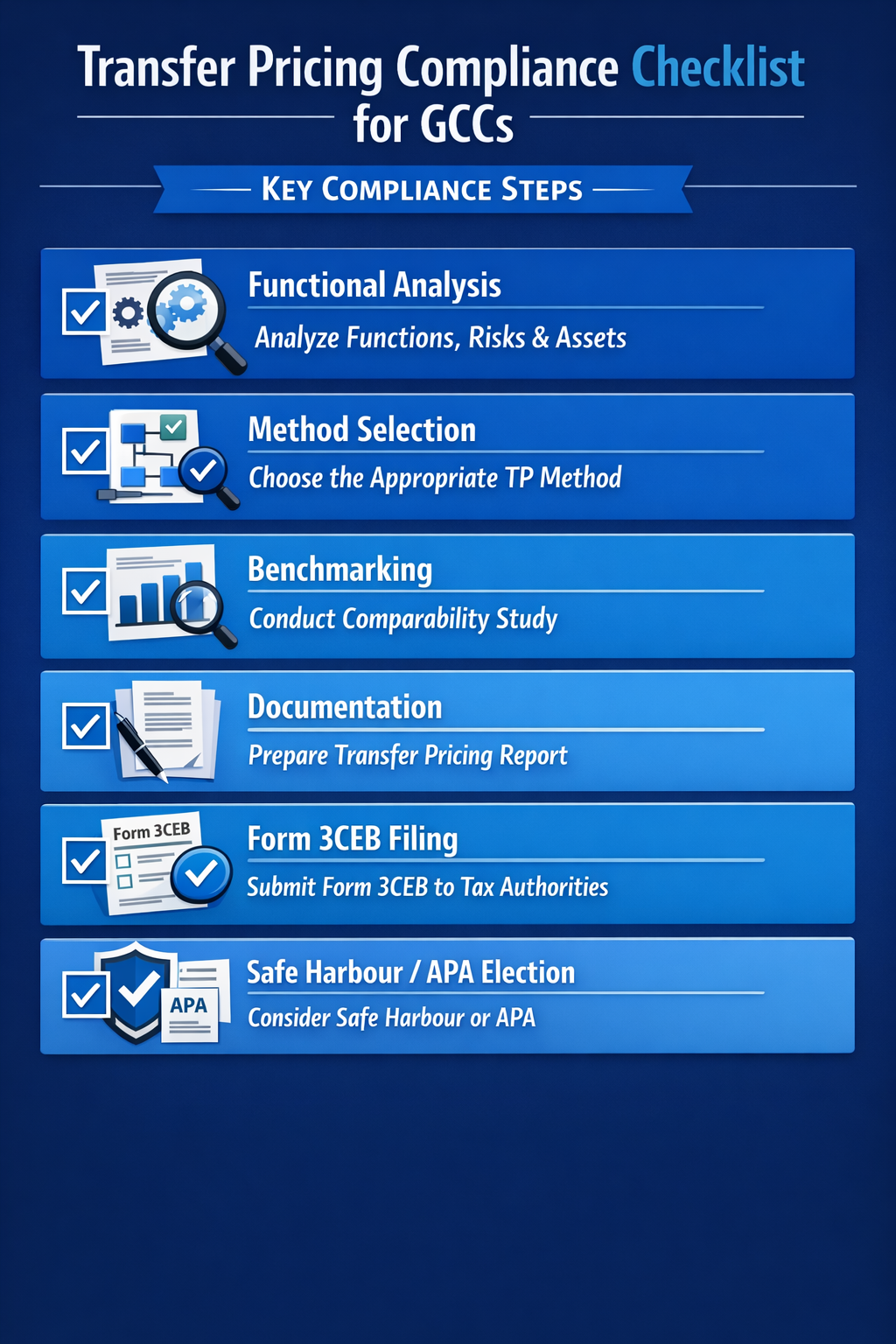
Regardless of whether a GCC opts for safe harbour or benchmarks independently, robust documentation is non-negotiable. Indian transfer pricing regulations mandate comprehensive records that justify the arm's length character of every intercompany transaction.
Core Documentation Requirements
• Master File: Group-level information on organizational structure, business operations, intangible assets, financial activities, and global allocation of income.
• Local File: Entity-level transactional details, functional analysis (functions performed, assets used, risks assumed), and economic analysis with comparable benchmarking.
• Country-by-Country Report (CbCR): Required for MNE groups with consolidated revenue exceeding INR 5,500 crore, reporting income, taxes, and economic activity by jurisdiction.
• Form 3CEB: A Chartered Accountant's certificate confirming maintenance of required documentation, due by November 30 of the assessment year.
Advance Pricing Agreements (APAs)
For GCCs that do not opt for safe harbour—perhaps because their operations involve complex IP arrangements or non-standard service models—Advance Pricing Agreements offer an alternative path to certainty. Budget 2026 introduced fast-tracked unilateral APAs for IT services with a target completion timeline of two years, significantly faster than the historical average of four to five years
Common Transfer Pricing Pitfalls for GCCs
Even well-structured GCCs encounter transfer pricing challenges. Understanding these pitfalls helps engineering leaders and finance teams avoid costly disputes.
1. Undervaluing the Indian entity's contribution: If your Indian engineering team develops core product features, contributes to patents, or creates proprietary algorithms, treating them as a low-risk service provider may not withstand scrutiny. The functional profile must align with the compensation model.
2. Misclassifying service types: Pre-2026, classifying R&D work as IT-enabled services (which carried a lower safe harbour margin) was a common tactic that triggered disputes. The unified 15.5% margin reduces this risk but doesn't eliminate it for companies outside the safe harbour threshold.
3. Inadequate contemporaneous documentation: Documentation must be prepared in real time, not retroactively. Indian tax authorities view after-the-fact documentation with skepticism, and failure to maintain records carries penalties of INR 500,000.
4. Ignoring the substance-over-form principle: Tax authorities look beyond contractual arrangements to assess actual economic substance. A GCC that contractually acts as a limited-risk entity but operationally makes strategic decisions and manages significant assets faces reclassification risk.
Conclusion
Transfer pricing is one of the most consequential regulatory obligations for any company setting up an offshore engineering team in India. The framework demands that intercompany transactions reflect genuine market economics, and India's tax authorities have the tools and intent to enforce compliance. However, the 2026 reforms—particularly the unified 15.5% safe harbour margin, expanded eligibility thresholds, and fast-tracked APAs—have significantly reduced uncertainty for GCCs.
Start by mapping your GCC's functional profile and selecting the appropriate pricing method, then evaluate whether safe harbour or an APA best fits your operating model. For organizations seeking expert guidance on establishing and scaling compliant GCCs in India, Crewscale specializes in building offshore engineering teams with the regulatory and operational infrastructure needed to get transfer pricing right from day one.


